 HRBC
Horse Racing Bettors Companion — Technical details
A closer description of how the research is put together. In Detail remains the shorter guide.
01
RFMS — Recent Form and Market Expectation System
Recent Form and Market Expectation System
1. Definition and purpose
RFMS stands for Recent Form and Market Expectation System.
RFMS is HRBC's pre-race horse ranking and the broad starting point for race analysis in Horse Racing Bettors Companion.
The system is deliberately focused.
Rather than combining every available characteristic of a horse, race, jockey, trainer and market into a single opaque figure, RFMS uses two principal pieces of evidence:
- A form score based purely on the horse's previous race
- The win BSP from that previous race, carried into today's race and ranked against the other runners' carried-forward previous win BSPs. The lowest BSP is rank 1. That BSP rank is the second metric
An algorithm uses those two metrics to produce an RFMS score for the horse's next race. The internal steps of that algorithm are not published.
The scores allow that field to be ranked, including a horse that does not run.
RFMS therefore answers an initial question:
Based on each horse's recent form and the market expectation around its previous race, where should the investigation begin?
RFMS is a starting point.
It is not a replacement for looking at today's race.
2. Core methodology
The calculation uses earlier races only. The race being scored does not contribute its own finish or its own BSP.
Conceptually, it asks two questions:
1. What was the horse's form score in its previous race?
That score is based purely on that race.
2. What BSP rank does that previous win BSP take among today's runners?
Each runner's previous win BSP is carried into today's race and ranked against the others. The lowest BSP is rank 1. Today's prices are not used.
An algorithm combines the form score and that BSP rank. The way the two are weighed is not published.
RFMS does not simply ask whether the horse won or lost its previous race.
3. Recent form component
The form part is a form score based purely on the previous race.
That score describes the previous race as it was. It does not reflect today's course, distance, going, class, field or any other circumstance of the race being ranked. It is the user's job to set today's race against the information in each previous race.
It is not a score built from the horse's whole career, and older races are not folded into it.
RFMS is therefore about that recent race. It does not compress the horse's career into one score.
Older performances remain available elsewhere in HRBC. They do not all become ingredients in today's RFMS score.
RFMS answers: what do the form score from that previous race, and the BSP rank among today's runners, suggest as a broad starting point?
The rest of HRBC is there to look at whether that evidence is supported or contradicted by the horse's wider history and by today's race.
4. Market expectation component
Market expectation in RFMS is the win BSP from the horse's immediately previous race. Betfair Starting Price is abbreviated to BSP.
Each runner's previous win BSP is carried into today's race and ranked against the other runners' carried-forward previous win BSPs. The lowest BSP is rank 1. That BSP rank is the second metric. It is not the horse's BSP rank inside its previous race, and it is not today's price.
The algorithm uses that BSP rank alongside the form score from the same previous race. It does not replace the form score with the price.
Today's BSP is not used.
5. Why previous market expectation is included
A form figure on its own does not say what the market expected before that earlier race.
A horse whose previous win BSP was short, and a horse whose previous win BSP was long, can have a similar form score from different market positions.
RFMS uses that previous market position as an adjustment. It does not treat those two cases as the same.
The aim is not to copy today's market. The aim is to use that BSP rank, from the previous win BSPs carried into today's race, as one part of the score.
6. Chronological calculation
RFMS is chronological.
A horse's RFMS score for a race is calculated from earlier races. The outcome of the race being scored is not used.
The sequence is:
Earlier race → RFMS score for the next race → that race → RFMS score for the race after it.
An RFMS score shown against a historical race is the assessment the horse carried into that race. It is not a rating awarded afterwards because of what happened in it.
The score belongs to the race in which it is shown. The evidence used to calculate it comes from earlier races.
7. No future information
The result of a race cannot be used to improve, or reduce, the RFMS score the horse carried into that race.
If a horse wins Race B, that result can feed the form score used for Race C. It cannot change the RFMS score the horse carried into Race B.
If a horse runs poorly in Race B, that can affect the assessment for Race C. It does not reduce the score carried into Race B.
Historical RFMS values are the method applied in date order. They are not rebuilt later from information that was not available beforehand.
8. RFMS score and RFMS rank
RFMS score is the figure the algorithm produces for one horse from those two metrics.
RFMS rank is that horse's place when the score is compared with the other horses in the ranking.
The highest score is rank 1, then rank 2, then rank 3, and so on.
A rank describes the horse's position against the opposition in that race. The score is the horse's own figure.
A historical rank 1 was rank 1 against the horses in that historical race. A historical rank 3 was rank 3 against a different field.
Ranks from different races are not the same measurement. The score is there when you want to see how the figure itself moved.
9. Today's market is not used
Today's Betfair price does not determine today's RFMS score.
The market part of RFMS is the BSP rank from the previous win BSPs carried into today's race. The lowest BSP is rank 1. It is not today's price, and it is not the horse's BSP rank inside its previous race.
Today's odds can still be moving when the racecard is open. RFMS does not change because today's market moves.
A horse can be highly ranked by RFMS when today's market disagrees. The eventual Betfair favourite is not automatically RFMS rank 1.
RFMS and today's market are separate. Agreement or disagreement between them is something to look at, not a result by itself.
10. Declared runners
RFMS on the racecard is worked out from the horses declared for the race, using earlier races only. A horse that does not run stays in that ranking.
A move in today's price does not change the score or the rank.
A non-runner keeps the number it was given. The others are not ranked again.
Highest ranked, 2nd highest and 3rd highest are the best of those numbers among the horses that run. If rank 1 does not run, the highest is the original rank 2, and the three are the original ranks 2, 3 and 4. Rank 2 is not given the number 1.
The racecard can still refresh current odds and non-runner status. The number stays. A change in today's price does not change the rank.
11. RFMS is a broad ranking
RFMS does not try to include every part of today's race.
It does not say that RFMS rank 1 is automatically the horse best suited to today's course, distance, going or surface, class, field size, race code, pace, jockey, trainer, month, or any other circumstance of the race.
Those questions belong to the rest of HRBC.
RFMS gives a broad opening order from the form score in the previous race and the BSP rank among today's runners.
RFMS provides the broad ranking. HRBC provides the evidence used to look at it.
12. Relationship with Last 5 all
Last 5 all is the default recent-form view. It shows the horse's five most recent qualifying races, without filtering them by course, going, distance, class or race code.
That keeps the recent order of the horse's races.
Because each RFMS score is built from earlier races, Last 5 all is the view for seeing how the score and the rank have moved through those races.
The historical RFMS figure on a past race is the figure the horse carried into that race. It is not a later re-rating of it.
13. Reading historical RFMS
The most recent race is on the left.
The RFMS score on that race was produced from the race before it. The form score and the win BSP from that most recent race then feed the score for the race after it, including today's race when that race is the latest one.
The same relationship runs back through the row.
You can look at how the score changed, how the rank changed, what the form score was in the race before, how that race's win BSP sat against the other runners, and whether the race evidence helps explain the move.
A rank in one race is not the same measurement as a rank in another. The score is the figure that can be compared as a number. The rank is the place in that field.
14. Last 5 views for a condition
Last 5 race details can also show races that match one condition of today's race.
The Show menu offers course, going, distance, class and race code. Field size and handicap are not filters on that menu.
These views are for looking at the horse. They are not RFMS calculation filters.
Choosing one of them does not recalculate RFMS and does not produce a separate RFMS for that condition.
Last 5 going (Heavy) retrieves qualifying races on Heavy. It does not produce a Heavy-ground RFMS score.
Last 5 course (Bath) retrieves qualifying races at Bath. It does not produce a Bath RFMS score.
The same applies to distance, class and race code.
15. Those views do not change RFMS
RFMS stays the same broad pre-race figure whichever Last 5 view is open.
The condition views do not recalculate RFMS, change today's score or rank, recalculate a historical RFMS, or create a course, going, distance, class or race-code version of the score.
RFMS is the algorithm's reading of the previous race. The Last 5 views are there to look at the races behind that figure.
16. Last 5 all and the condition views
16.1 Last 5 all
This is the recent order of the horse's races.
It is the view for recent performances, how the RFMS score and rank moved, the previous-race market position, early pace and finish, and the run of races leading to today's score.
16.2 A condition view
This retrieves historical races for one question about today's conditions: course, going, distance, class or race code.
It can show races older than the horse's five most recent races overall. That is intentional.
Last 5 all asks what happened most recently. A condition view asks what evidence there is about that part of today's race.
17. No races for a condition
A condition view can return no qualifying races.
That is not automatically negative evidence.
If today's race is on Heavy and Last 5 going (Heavy) has no races, the reading is that no qualifying Heavy evidence is in that view.
It does not mean the horse is unsuited to Heavy.
No evidence is not the same thing as poor evidence. A lack of comparable races is uncertainty. It does not by itself prove unsuitability.
18. Where today's score came from
Today's score comes from the form score in the previous race and from the BSP rank of that race's win BSP among the other runners declared today.
That previous race can be read in Last 5.
The questions are what the form score was, what BSP rank that previous win BSP took among today's runners, what the horse did, and whether that race looks like today's race.
The page is not only a rank number. The races behind the score are on the form.
19. Looking at today's race
A high RFMS score is not confirmation that today's conditions suit the horse.
It is a starting point. The previous race may have been at the same distance, in the same class, at the same course, and against a similar field, and still have been on different going.
That does not make the RFMS figure wrong. It has done what it is built to do. The going difference is a separate question, and the going view is there for that question.
20. Colours on Last 5
Last 5 race details compares historical race conditions with today's race.
The colours do not say whether a horse is a good or bad selection. They mark a relationship in the evidence.
On distance, class, going and runners, green matches this race, orange is one step away, and red is further away. A course is green at today's venue and orange at any other. A race code is green when it is the same, orange when it is related, and black when it is not comparable.
Early pace runs from led in green to rear in red. Finish style runs from ran on in green to early fade in red. Those colours are not a better or worse result.
On the performance rows, including RFMS rank, green is better than the run to the right, orange is the same, and red is worse. A lower RFMS rank is treated as better. A rank in one race is still not the same measurement as a rank in another.
The full colour rules are in the Recent form chapter.
21. Performance direction
Last 5 also shows whether a measure improved, stayed the same, or got worse compared with the run to its right.
That comparison includes finishing position, percentage of runners beaten, finishing margin, RSPD rank and RFMS rank.
Early pace and finish style are descriptive. They are not an automatic better or worse comparison with the previous run.
22. Comments
The figures describe parts of the performance. The colours mark relationships. The race comment is the written account of what happened.
A comment can mention the start, early position, a challenge, the horse being headed, rallying, weakening, staying on, interference, or another event recorded in the result.
That is useful when the question is what happened in the race that later went into an RFMS score.
23. Two different questions
RFMS asks what the form score from the previous race, and the BSP rank among today's runners, suggest as a broad starting order.
The condition views ask how relevant the historical races are to today's race.
Those questions can point in different directions without either being a mistake.
RFMS may rank a horse highly because the recent figure is strong. The going view may then show little evidence on today's going. That can be read as strong recent evidence, and uncertainty about today's conditions. The uncertainty is part of the decision.
24. A starting point, not a verdict
RFMS sets an opening order. The rest of the work is to look for evidence that supports it, weakens it, or leaves it uncertain, including evidence about a lower-ranked horse.
The aim is not to confirm RFMS. Evidence that cuts against it can be as useful as evidence that agrees with it.
25. The field, then the horse
RFMS ranks the declared field. Last 5 race details is the closer look at one horse.
That closer look can include recent races, course, distance, going, class, race code, market history, early pace, finish style, the direction of the figures, the trainer and jockey, and the comments.
The same look can then be made at the opposition.
The rank is an opening order. It is not a claim that one number holds every relevant fact.
26. Two metrics
RFMS uses an algorithm with two metrics from the previous race, and no others.
One is the form score in that race. The other is the BSP rank of that race's win BSP among the other runners in the current race. The lowest carried-forward BSP is rank 1.
Course, distance, going, class and the rest of the race are not folded into that figure. They stay visible in the other tools.
27. Why the context stays outside the score
Course, distance, going, class and other facts could have been folded into one score. HRBC keeps them outside RFMS.
A single combined score makes it harder to see why a horse received a figure. The relevance of one fact can also depend on the race and on the reading of the evidence.
The rank and the evidence that may support or challenge it are both visible. The detail is organised, not hidden inside the number.
28. Historical testing
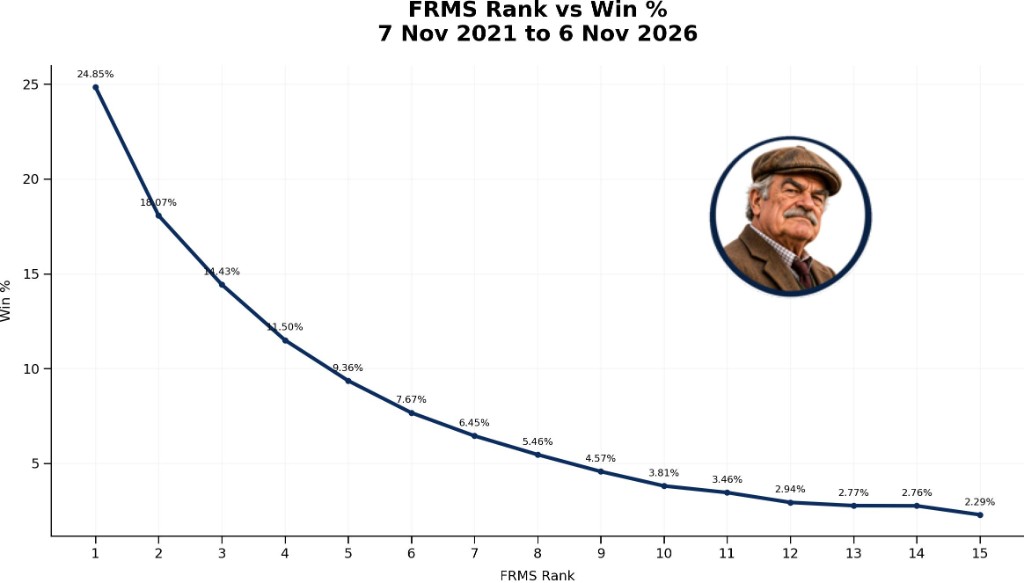
RFMS has been examined over historical periods, including three months, one year, three years and five years.
That work has looked at win rates by RFMS rank, place rates, whether the pattern holds across periods, how rank relates to the result, how it relates to market prices, and how it behaves across large numbers of historical races.
A method that looks exceptional over one short period and different over longer periods is a weaker starting point than a method whose behaviour is steadier across those periods.
The published win and place table on the racecard is a separate count of historical ranks. It is not a forecast.
29. Historical results are not a prediction
Historical RFMS results are evidence of how the method has behaved. They do not guarantee the same results in future races.
A historical win percentage for a rank is an observed rate in past races. It is not the chance of one horse in one race.
Each race has its own field and its own evidence. The historical counts are context for the ranking. The race still has to be looked at.
30. Rank and price
RFMS rank and the attractiveness of a price are different questions.
A higher-ranked horse can have a higher historical win rate than a lower-ranked horse and still be a poor price. A lower-ranked horse can be the more interesting price if the odds are large enough for the chance being taken.
RFMS rank 1 is not an instruction to bet. RFMS rank 2 is not the second-best bet.
The rank is the RFMS order of the declared runners. A betting decision also takes in today's race, the opposition, what is unknown, the price, and the reading of the evidence.
The horse that looks most likely to win and the bet that looks most attractive are not always the same horse.
31. RFMS and today's market
Because today's price is not used to build the rank, RFMS and today's market can agree or disagree.
Agreement means both have picked out similar runners. Disagreement is a place to look. Neither is right merely because it differs from the other.
The market contains a great deal of information. RFMS is a separate order, built from the previous race, before today's price is taken into account.
32. Limits
RFMS is a broad figure, and it has limits.
It uses the previous race. That race may have been very different from today.
A horse may have little recent evidence. It may be changing surface, distance, class, race code, course or field size. Something about the latest run may not fit in one number.
RFMS does not settle those questions. The other HRBC tools are there so they can be looked at.
33. Missing evidence
Horses do not all have the same amount of evidence. Some have short histories. Some have no race under the condition being looked at.
The score should be read with that in mind. Where the evidence is not there, HRBC does not fill the gap.
The honest reading can be that it is unknown.
On a condition view, no qualifying race is information about what is available. It is not automatically evidence of poor suitability.
34. A way to use it
- Start with the RFMS order of the declared runners.
- Look at the previous race: its form score, and the BSP rank that race's win BSP takes among today's runners.
- Open Last 5 all and read the recent races in order, including how the RFMS score and rank moved.
- Decide which parts of today's race matter. Course, going, distance, class and race code are the Show filters.
- Open the matching Last 5 view. That view does not recalculate RFMS.
- Notice what looks relevant, similar, different, or simply missing.
- Do the same for the opposition.
- Look at today's price separately from the question of which horse looks most likely to win.
- Decide. The evidence may support the order, weaken a highly ranked horse, point at a lower-ranked horse, or leave too much unknown. No bet is a possible conclusion.
35. What the rank means
RFMS rank 1 is not HRBC's prediction of the winner.
RFMS rank 1 is the runner with the highest RFMS score in this field, including a horse that does not run. That score is the algorithm's reading of the form score in the previous race and of the BSP rank of that race's win BSP among today's runners.
That is a starting point. It does not contain every relevant fact about today's race.
The rest of HRBC is there to see whether the races behind that score look relevant, supportive, contradictory, or thin.
36. RFMS, Last 5 all, and the condition views
36.1 RFMS
The broad rank, from the form score in the previous race and the BSP rank among today's runners.
36.2 Last 5 all
The recent races in order, so the move in the score and the rank can be read.
36.3 A condition view
Course, going, distance, class or race code. These views add context. They do not change RFMS.
The three stages are the ranking, the recent sequence, and the look at today's conditions.
37. What is visible
The two inputs are public. One is the form score in the previous race. The other is the BSP rank of that race's win BSP among the other runners in the current race, lowest BSP first. The algorithm that combines them is not published.
The historical races are on the form, so a high score can be inspected. The races behind it may look like today, or they may not. Both findings are useful.
38. Design
Use the recent form figure and the previous market position to decide where to start. Then look at whether that evidence matters today.
The broad rank stays separate from the detailed look at course, going, distance, class and race code.
Last 5 all keeps the recent sequence. The condition views investigate today's race without changing RFMS.
The aim is not to replace a decision with a number. It is to give an opening order and keep the evidence available.
39. Summary
RFMS ranks the declared runners before the race.
The score comes from an algorithm. Its two inputs are the form score in the previous race, and the BSP rank of that race's win BSP among the other runners declared today. The lowest BSP is rank 1. Today's price is not used.
That BSP rank is worked out in today's race. It is not the horse's BSP rank inside its previous race.
The form score does not reflect today's race. The user sets today's circumstances against each previous race.
A historical RFMS figure is the figure carried into that race. The result of that race is not used to build it.
A non-runner keeps its number, and the others are not ranked again. Highest ranked means the best of those numbers among the horses that run. A move in today's price does not change the rank.
Last 5 all shows the recent sequence. Course, going, distance, class and race code views show evidence for one part of today's race. They do not recalculate RFMS.
RFMS says where to start. Last 5 all shows the recent races. The condition views show what is there for today's conditions. The decision remains with the user.